INTRODUCTION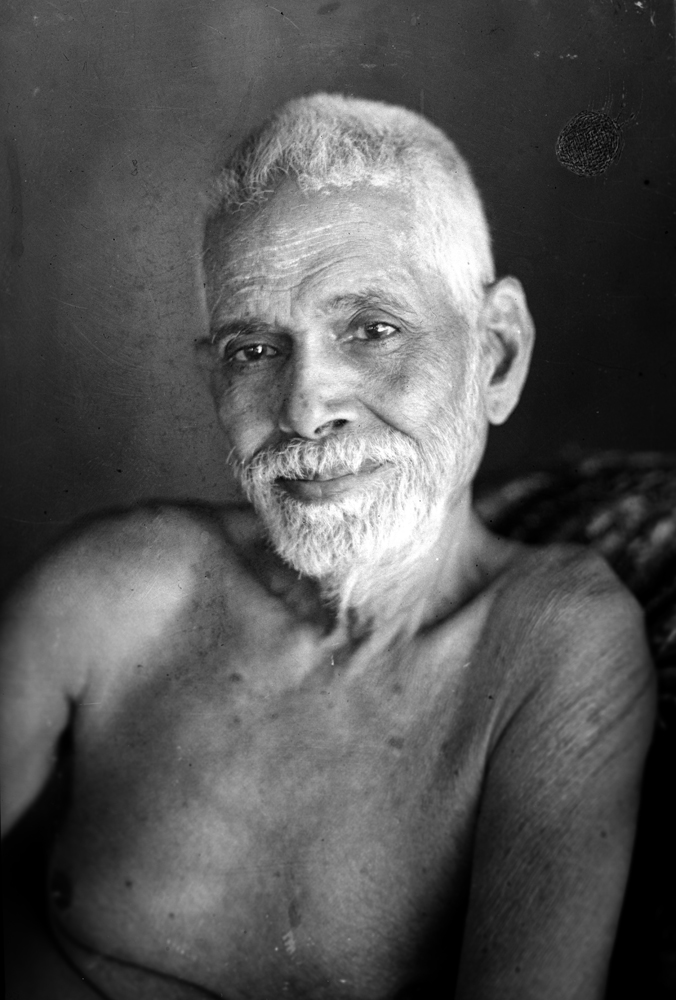
Ramana Maharshi {{PD-US}}
G. G. Welling, Public domain,
via Wikimedia Commons
At dawn on Arunachala Hill, the mountain breathes before the sun appears. The stone steps are cool under bare feet, and the air carries the scent of dust and jasmine.
In a small hall at the base of the hill, a man sits unmoving, his gaze neither fixed nor wandering. There is no instruction, no posture, no chant.
Yet something unmistakable happens in the stillness. This is the yoga of Ramana Maharshi—not practiced, but revealed.
Yoga Without Posture
Visitors arrived expecting techniques. They had come from Europe, from Bengal, from distant villages, carrying questions about breath control, chakras, and mantras. They found instead a man wrapped in silence. Ramana Maharshi did not demonstrate asanas or prescribe pranayama. He sat, often motionless for hours, as if the body itself had forgotten it was being inhabited.
And yet, those who sat near him felt their breath soften, their thoughts slow, their sense of “I” begin to loosen. Yoga, in his presence, was not something done. It was something that happened.
This was jnana yoga, the yoga of knowledge—not intellectual knowledge, but direct recognition. Ramana Maharshi’s teaching did not add anything to the seeker. It removed what was false.
The Moment of Awakening
At sixteen, Ramana was not searching for enlightenment. One afternoon, alone in his uncle’s house, an overwhelming fear of death seized him. Instead of fleeing it, he lay down and watched. He watched the body grow still, the breath stop, the limbs become rigid. Then he asked—without words—If this body is dead, what remains aware?
In that instant, something irreversible occurred. Awareness stood alone, untouched by the imagined death. The boy who would become Ramana Maharshi discovered the Self not through discipline, but through fearless attention.
That moment became the axis of his yoga teaching.
Self-Inquiry as Living Yoga
Ramana Maharshi did not call his path “yoga” in the conventional sense. But seekers soon understood that self-inquiry (atma vichara) was yoga in its most distilled form. Instead of controlling the mind, he asked students to trace it.
When a thought arose, he would quietly suggest: To whom does this thought occur? The answer came: To me. Then the next question: Who am I?
This was not meant as a philosophical exercise. Sitting in the ashram hall, with flies buzzing and devotees coughing, seekers tried it. A worry about money appeared. To whom? A memory surfaced. To whom? Each time, the attention turned back—not to an idea of the self, but to the felt sense of “I.”
Over time, that “I” dissolved like mist under sunlight.
This was yoga not as effort, but as abidance.
The Body Left to Itself
Unlike many yogic systems, Ramana Maharshi did not reject the body—but he did not center it. His own body bore scars: burns from cooking fires, untreated illnesses, a cancer that eventually consumed it. He watched it all with the same calm curiosity he offered his thoughts.
Devotees were disturbed by his indifference to pain. He was not demonstrating endurance; he simply did not identify with the sensations. In this, his teaching showed itself wordlessly: freedom is not the absence of pain, but the absence of identification.
Yoga, in this light, was not about perfect health or longevity. It was about seeing the body as an appearance in awareness, no more defined than a passing cloud.
Silence as Transmission
Often, visitors left disappointed. Ramana Maharshi answered few questions and spoke even less. But others left transformed, unable to explain what had happened.
Sitting before him, minds slowed. Thoughts lost urgency. The usual inner narration—I am this, I must become that—fell quiet. His silence was not empty; it was saturated.
This silence became one of the most powerful expressions of his yoga teaching. It suggested that truth is not conveyed through instruction but caught through presence.
In yogic terms, this was sahaja samadhi—natural, effortless absorption. Not attained in meditation and lost afterward, but woven into ordinary life.
Renunciation Without Escape
Though he lived simply, Ramana Maharshi did not promote outer renunciation. Household devotees came daily, carrying children and responsibilities. He did not ask them to leave the world.
“Where can you go?” he once asked gently. “The mind goes with you.”
Yoga, as he lived it, was not withdrawal but clarity—seeing the world without clinging. He milked cows, chopped vegetables, joked with devotees. Enlightenment, in his presence, wore no special costume.
This grounded simplicity made his teaching radical. It stripped yoga of its exoticism and returned it to its essence: freedom from misidentification.
Beyond Techniques, Toward Truth
Modern yoga often emphasizes improvement—greater flexibility, better focus, emotional balance. Ramana Maharshi pointed somewhere else entirely. He asked: Who is seeking improvement?
In his teaching, yoga was not a means to become a better person. It was the end of the false person altogether. This did not result in detachment or coldness, but in a quiet compassion that required no performance.
Visitors noted how animals trusted him. Peacocks wandered into the ashram. Monkeys sat nearby without fear. In his presence, even restless minds felt recognized.
The Living Legacy
Today, Arunachala still stands, unchanged. The ashram remains, though Ramana Maharshi’s body was laid to rest decades ago. Yet seekers continue to sit, often saying little, feeling something subtle align.
His yoga teaching endures not as a system, but as an invitation: to turn attention inward, to question the assumed self, and to rest in what remains when effort ceases.
There is no promise of visions or powers. There is only the quiet recognition that what you are seeking is already present—aware, silent, untouched.
And like the mountain at dawn, it does not announce itself. It simply is.


No comments:
Post a Comment